Product Overview
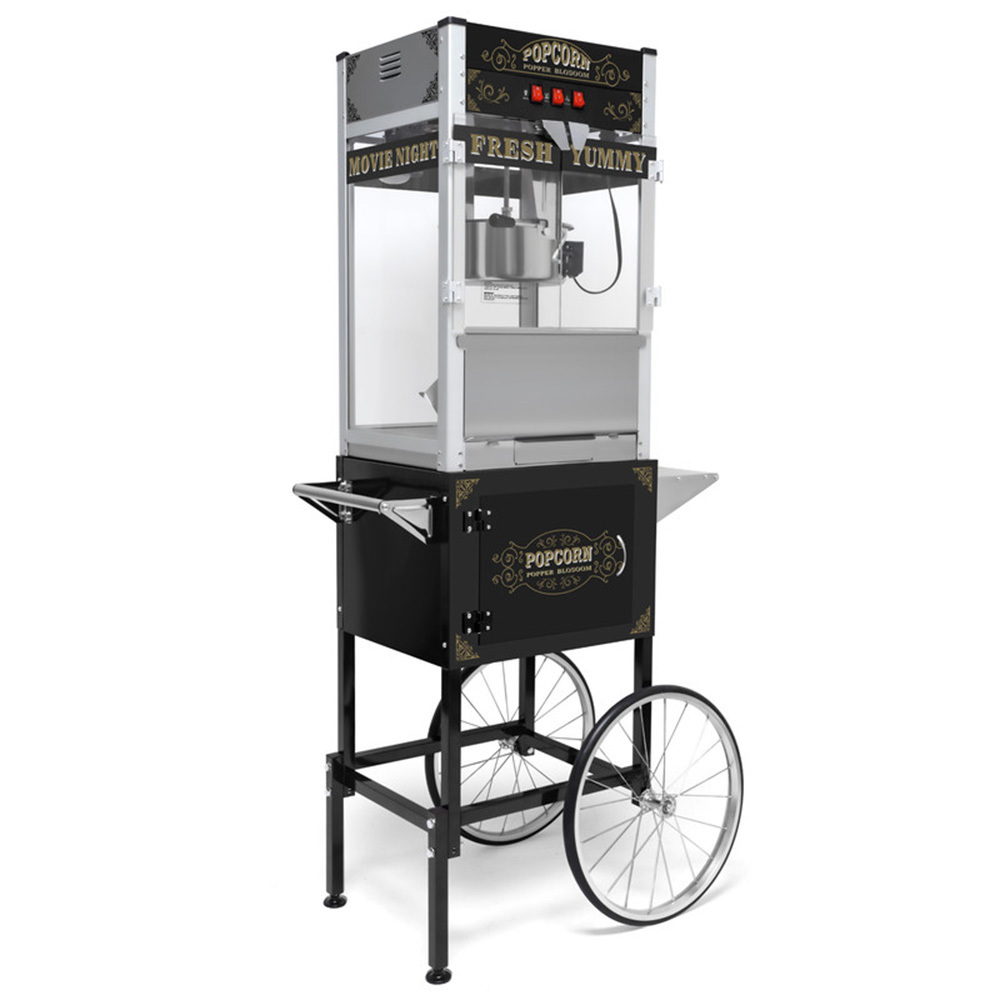
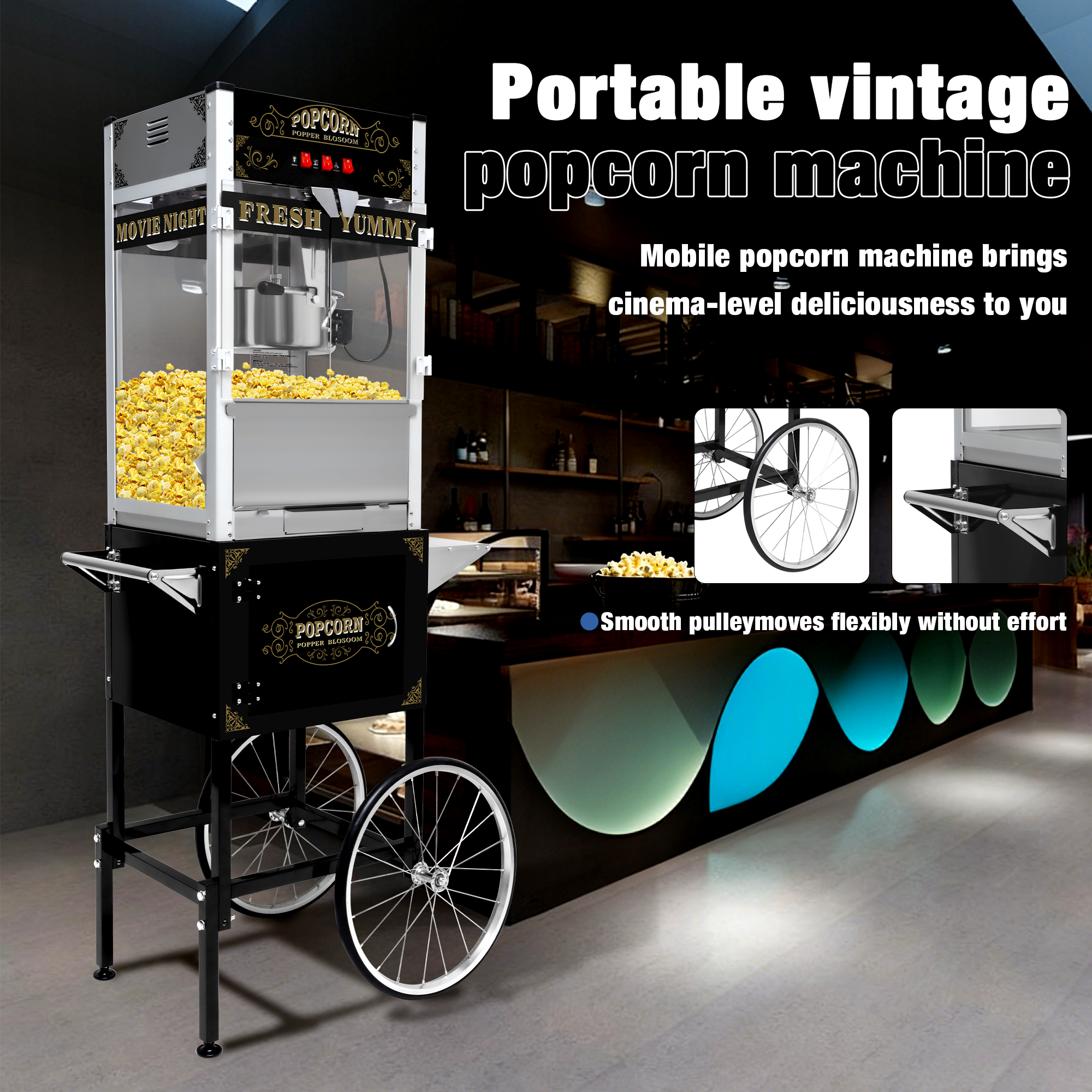
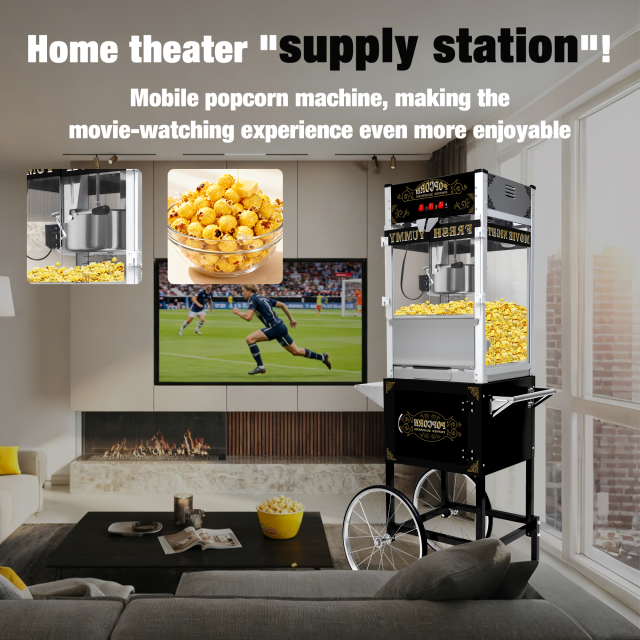
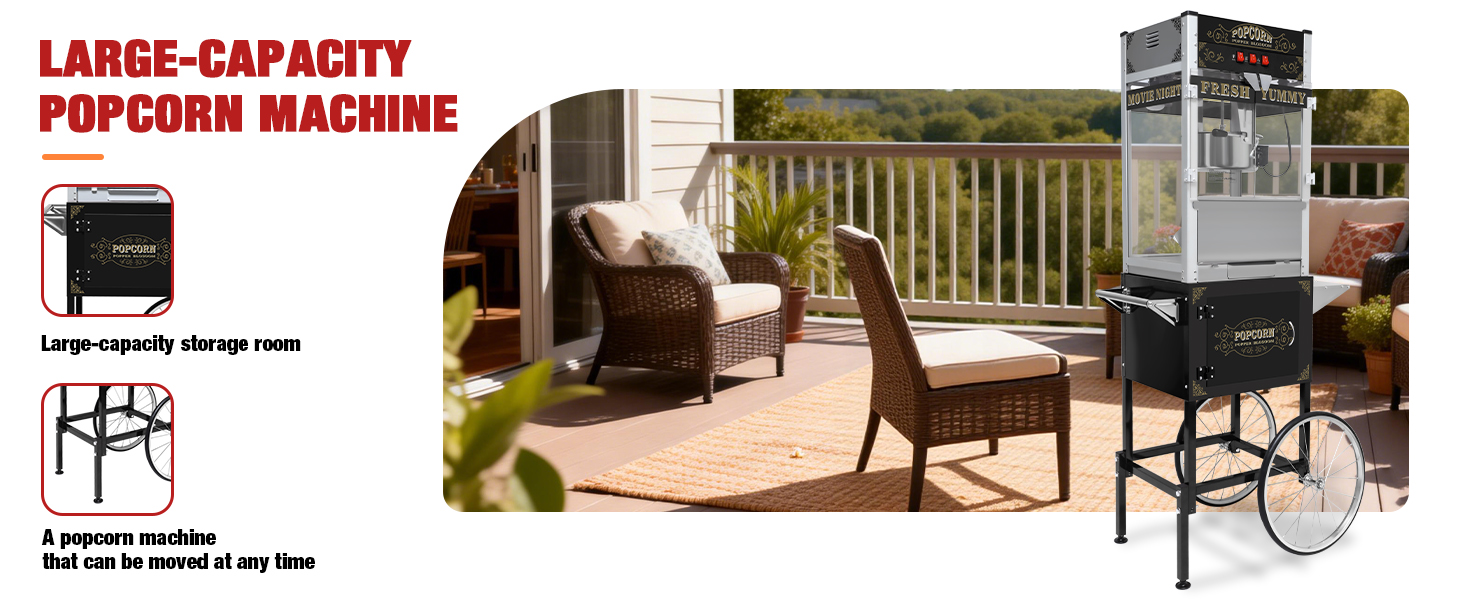
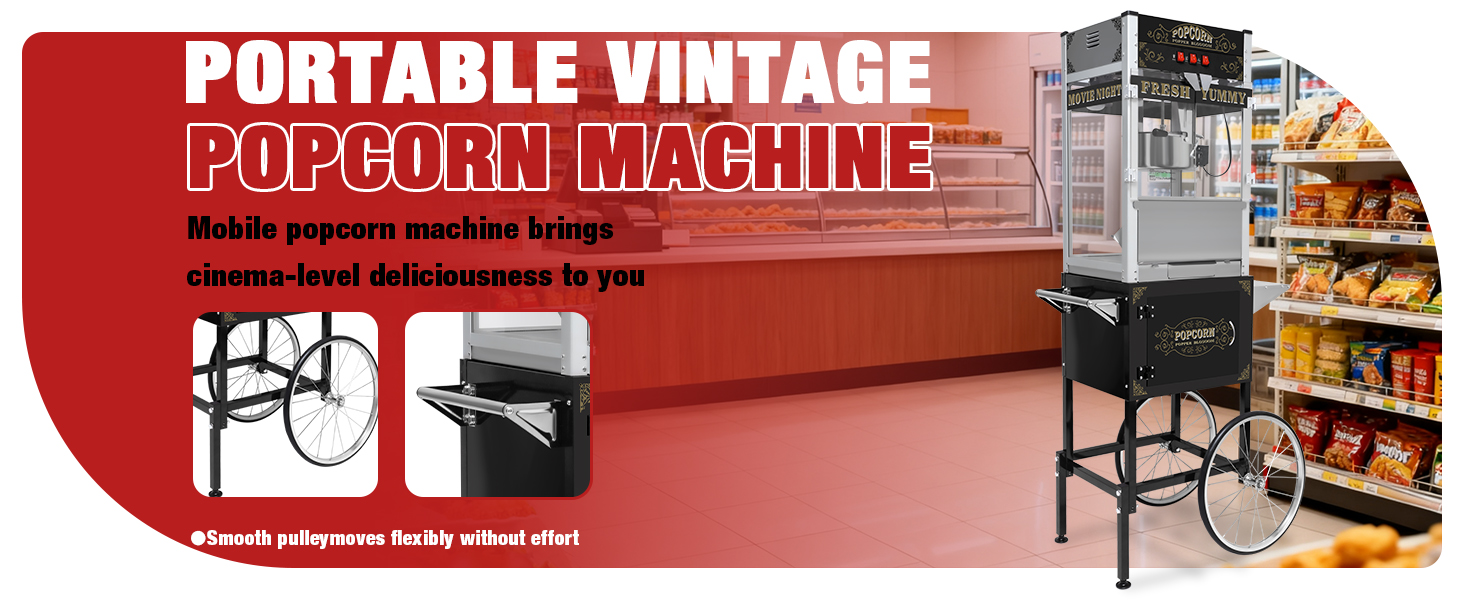
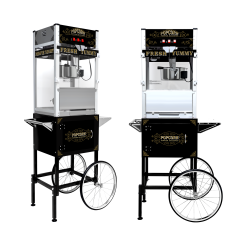
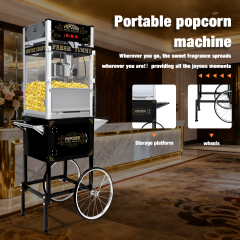
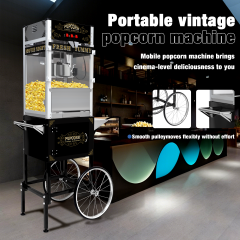
The 1205 is a 20 oz popcorn machine built onto a wheeled cart rather than a countertop base, and that one decision shapes everything else about it. It rolls into a den for a film night, moves to the front of a shop for the afternoon rush, and parks back against the wall when the floor is needed for something else. Nothing is scaled down for occasional use: a full-size kettle sits inside a clear popping chamber, and the cabinet beneath it is built like shop equipment rather than a kitchen appliance.
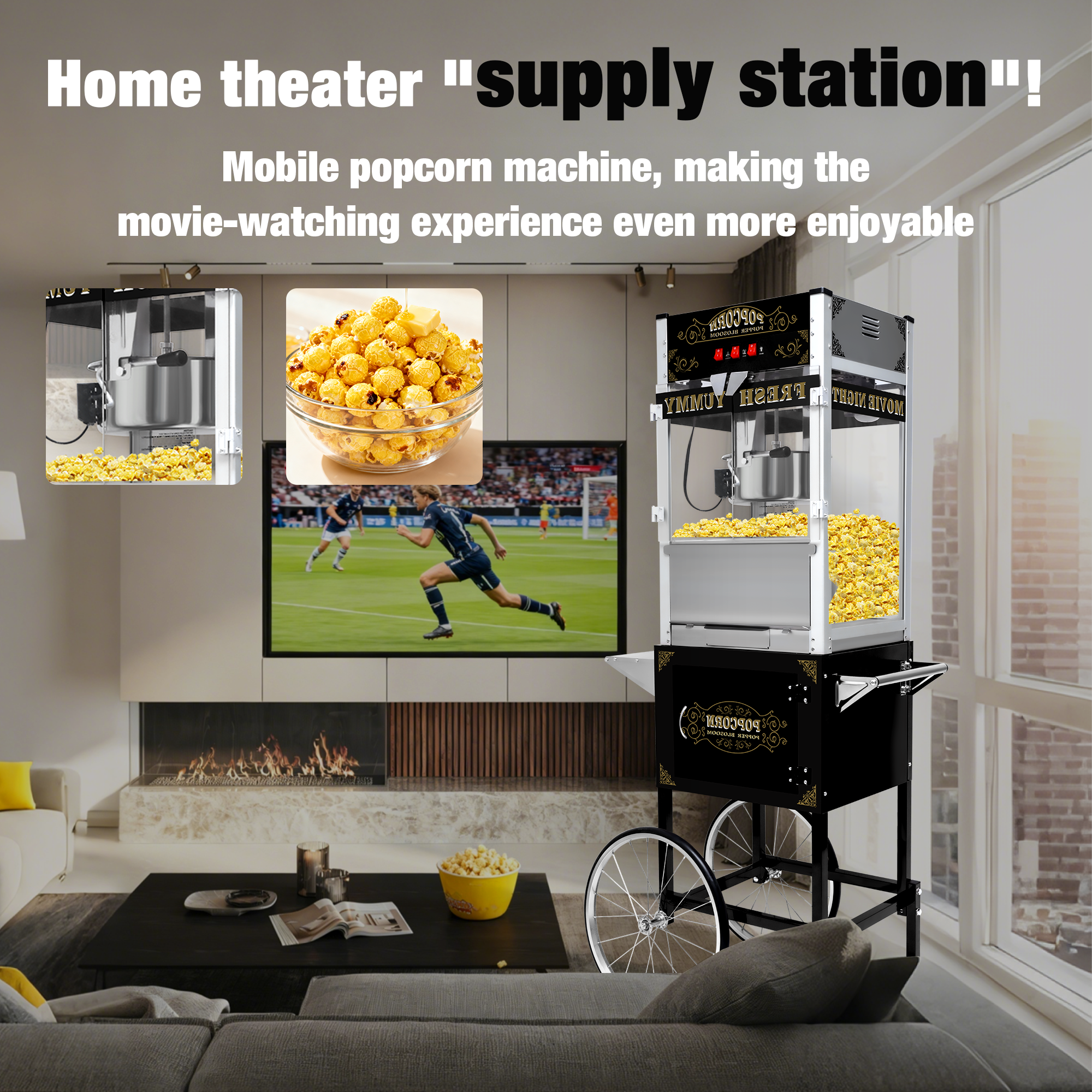
Dual use means two kinds of buyer work from the same machine. At home it replaces a countertop popper that turns out one bowl at a time — the job a home theater popcorn machine is usually bought for, minus the shelf-sized batch. In a shop — a convenience store, a café, a cinema foyer, a weekend pitch — it does the work of a display popper without claiming the floor space of a full concession stand.
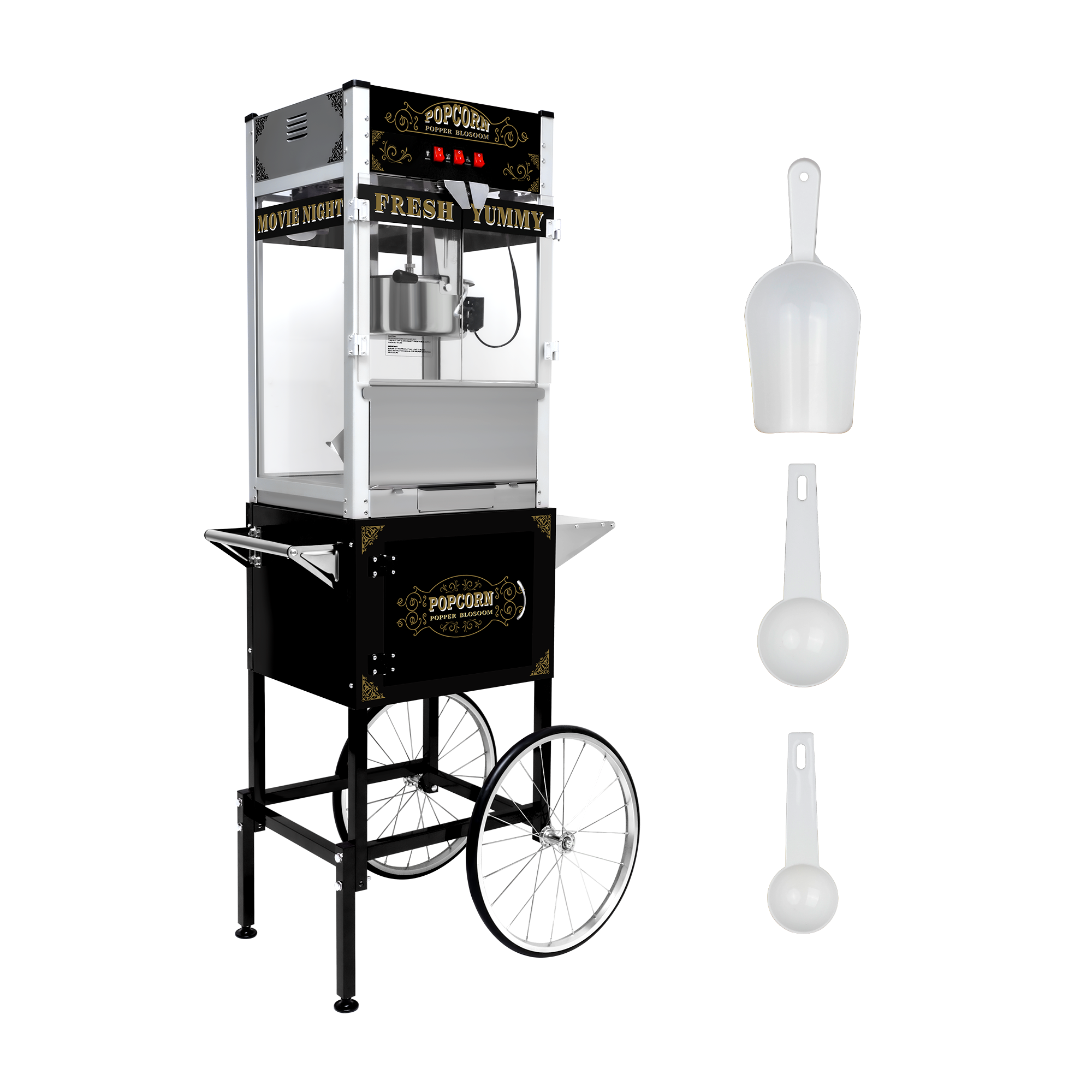
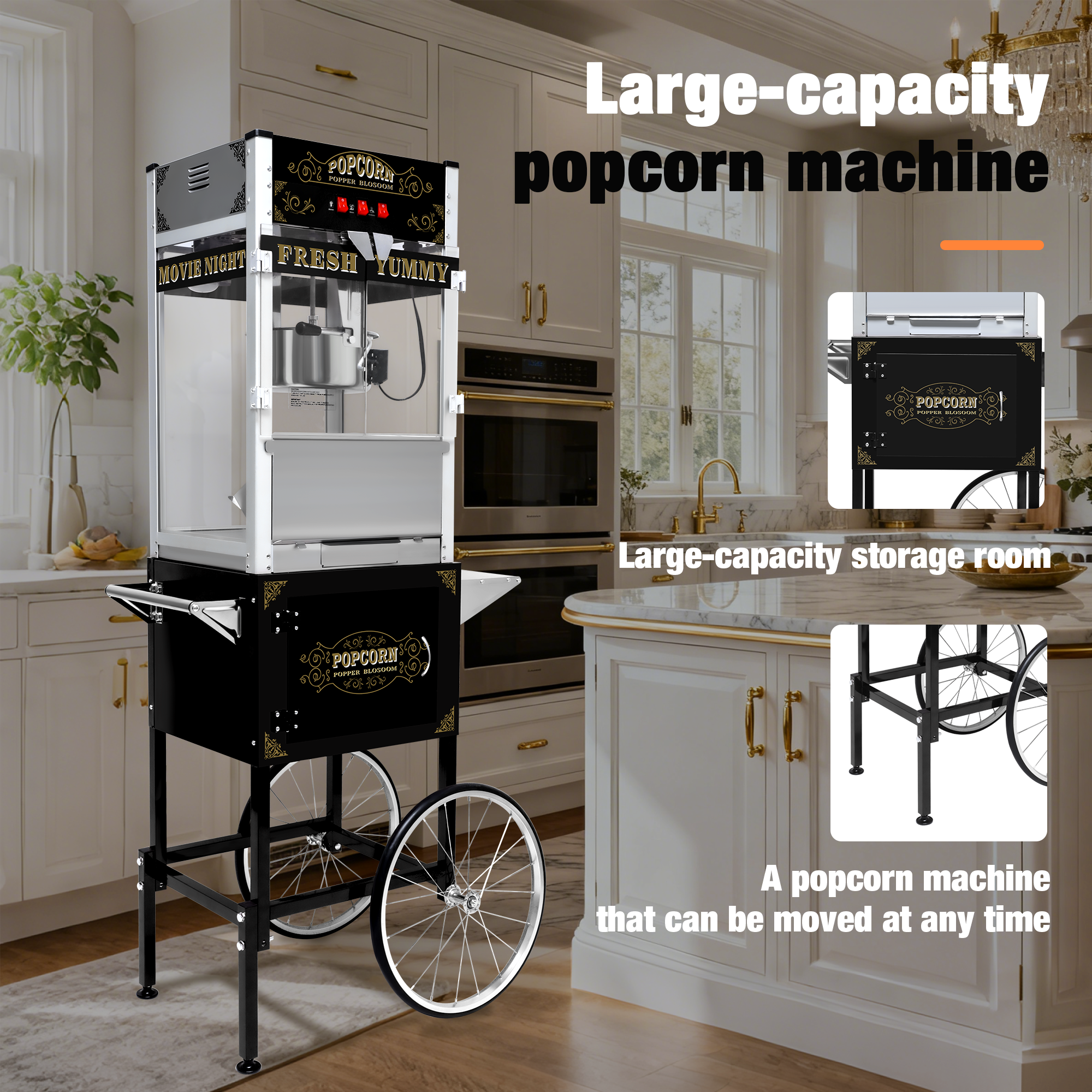
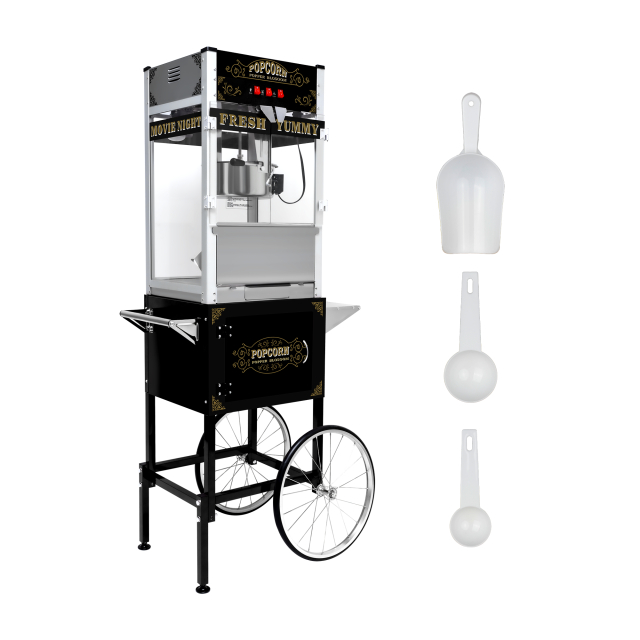
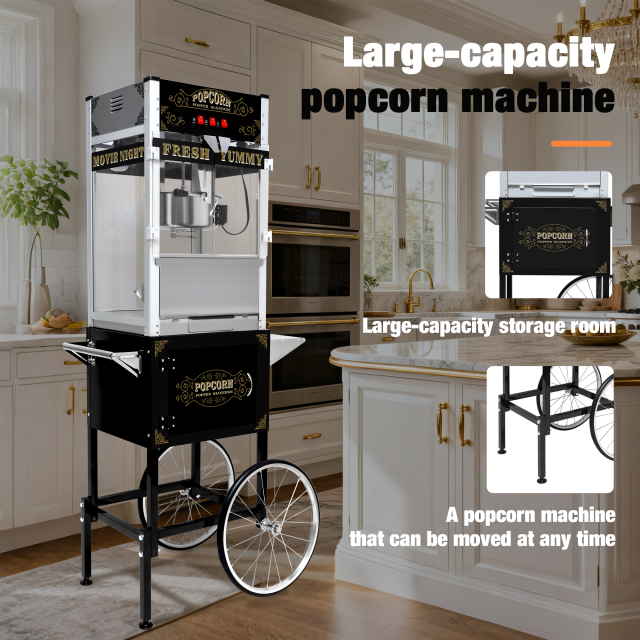
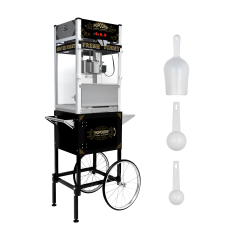
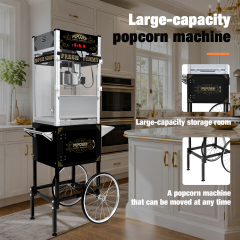
The compartment under the chamber is storage, not decoration: tubs, corn and oil travel with the cart, and the scoop and measuring spoons supplied with the machine ride in it too. Few popcorn machine manufacturers put a kettle this size on a cart this compact — if you have to serve a queue and your back room is a cupboard, this is the shape that answers both.
Batch Capacity & Where It Works
- What one drop gives you — a 20 oz kettle, about 1,000 g of popped corn per batch, and roughly six minutes from a cold load to an empty kettle. That is what a 20 oz popcorn machine buys you: a display case refilled or a room served, depending on where the cart is standing.
- Behind a counter — one drop restocks the case, and the next kettle goes on while the first batch is being bagged. The line sees a full case instead of watching one empty, which is the pace a commercial popcorn machine has to hold.
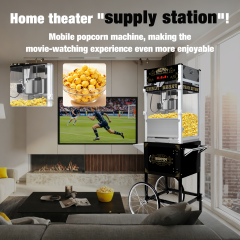
- In a home theater — a single batch covers a full room with some left for a second round, so nobody pauses the film for the popper. Buyers shopping for a home theater popcorn machine at this capacity usually stop comparing once the batch weight is in front of them.
- At a market pitch or an event — the wheeled popcorn cart rolls in ready to pop, and the batch size keeps a short queue moving without a second machine on the pitch.
- Against a small popcorn machine — a countertop popper is sized for a kitchen shelf, and its batch is gone before a room is served. This cart trades that shelf footprint for a batch that goes around.
- One kettle at a time — batches run one after another, and the cycle, not a conveyor, sets the pace of the counter. A dual use popcorn machine is built for that rhythm rather than continuous production; if you need popcorn produced continuously, a larger machine is the honest answer.
- Who it is not for — anyone who wants a mini popcorn machine for a worktop and nothing more. This cart is bought when the machine has to move, or when one batch has to serve more than a bowl.
Cart Build & Mobility
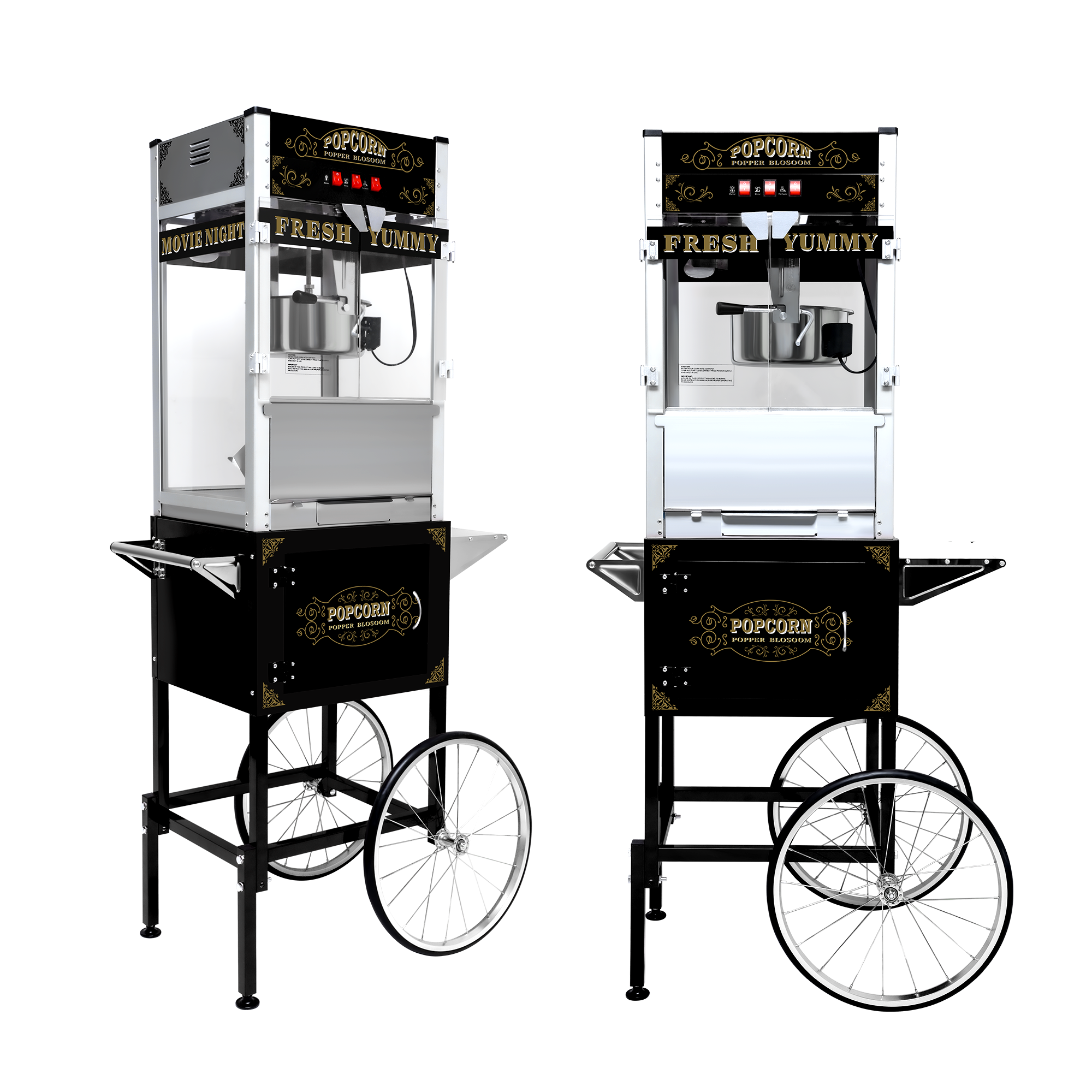
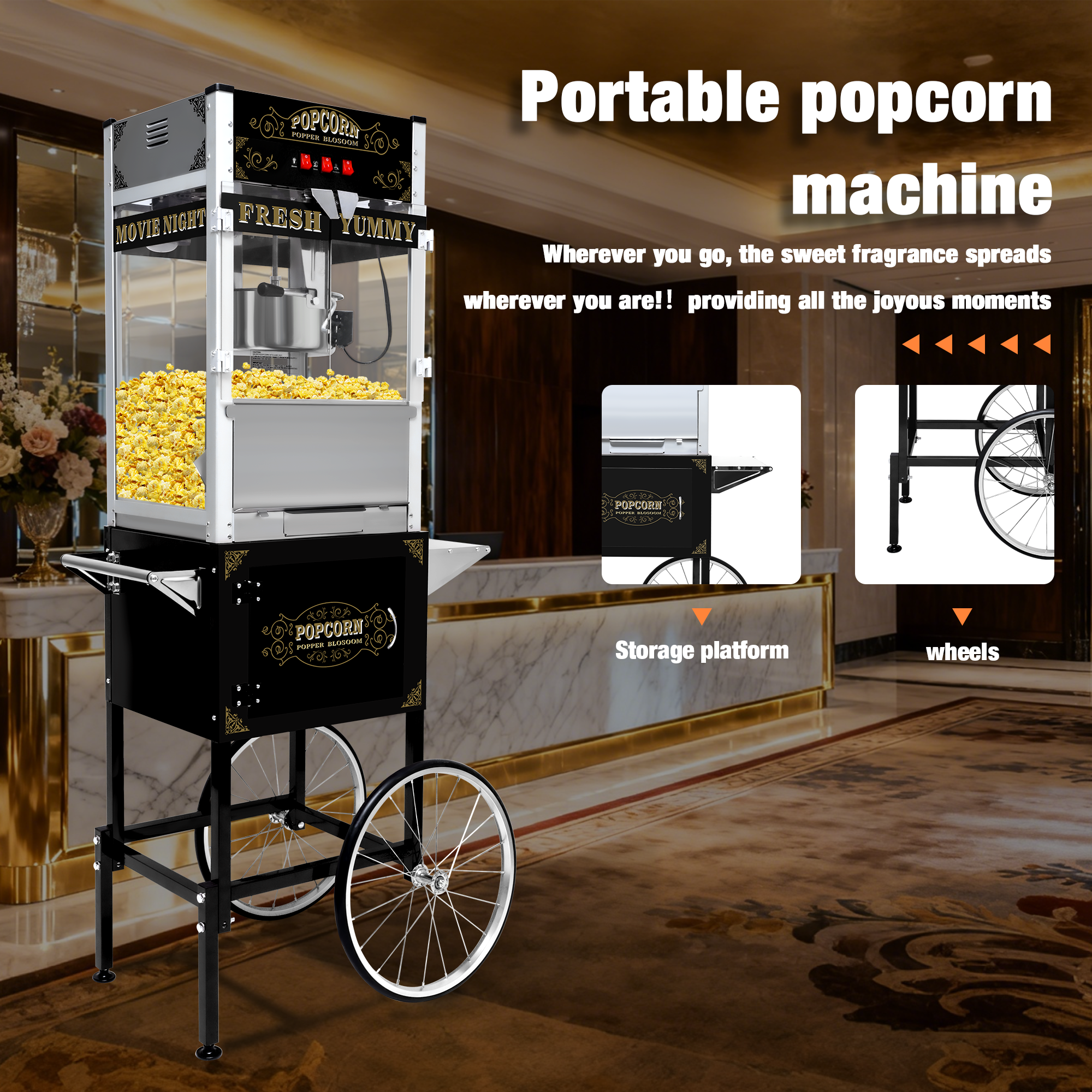
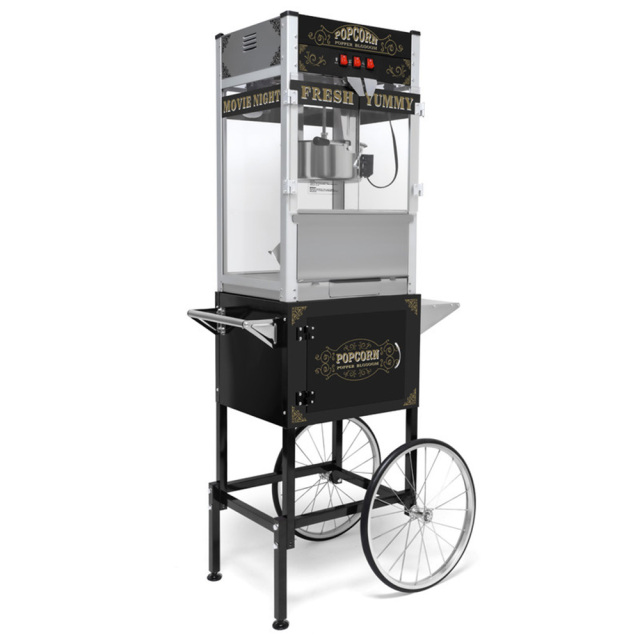
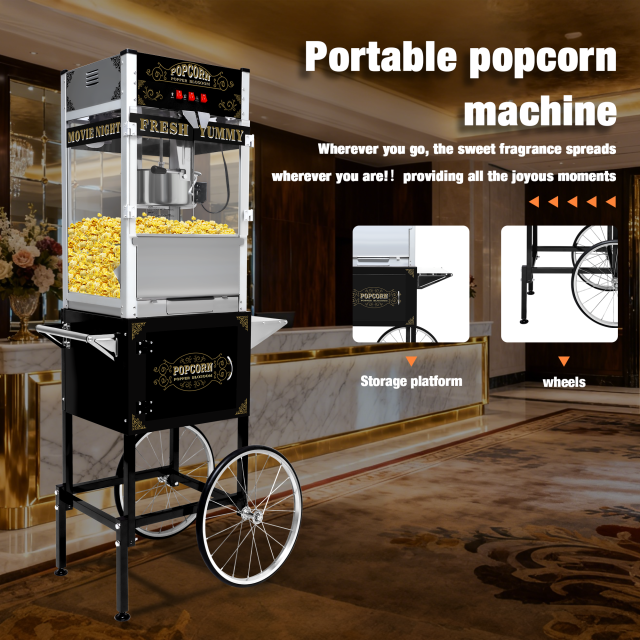
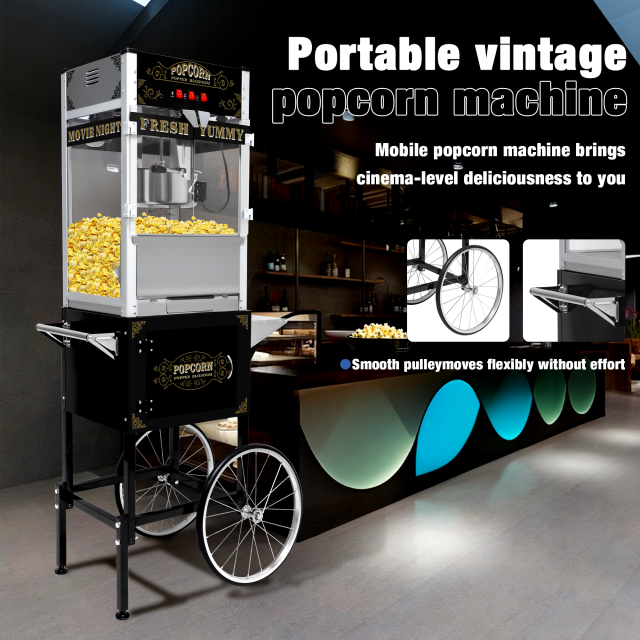
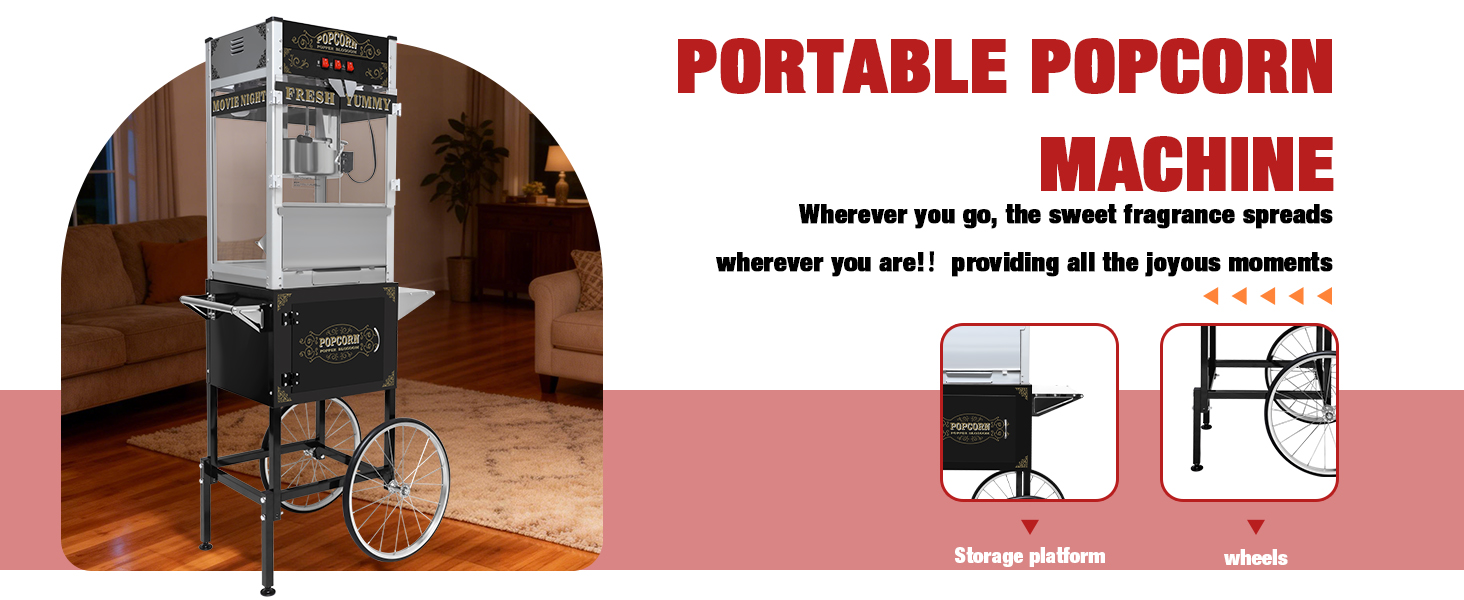
Most popcorn machines in this class sit on a fixed base, which is fine until the room has to be used for something else — less so for a home theater popcorn machine that has to clear the floor between films. This one is a cart: spoked wheels under the cabinet, a push handle at the side, and lifting handles on the body so two people can get it into a van without wrestling it. The wheels carry it across a flat floor and the handles take the weight when it has to be lifted.
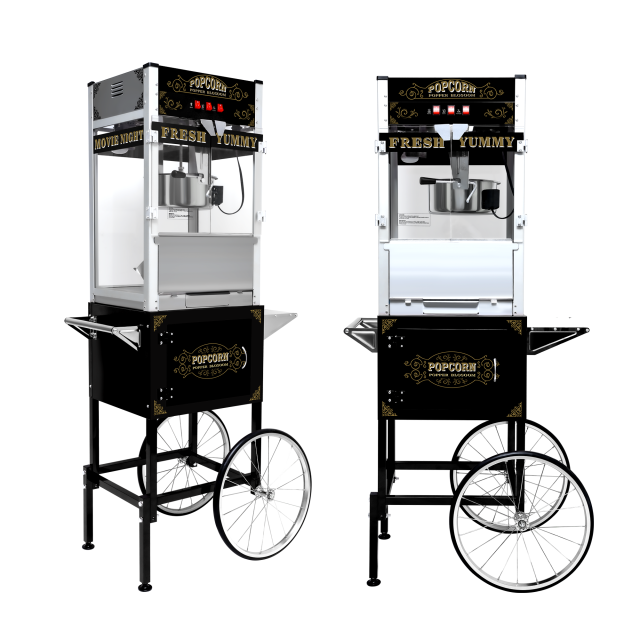
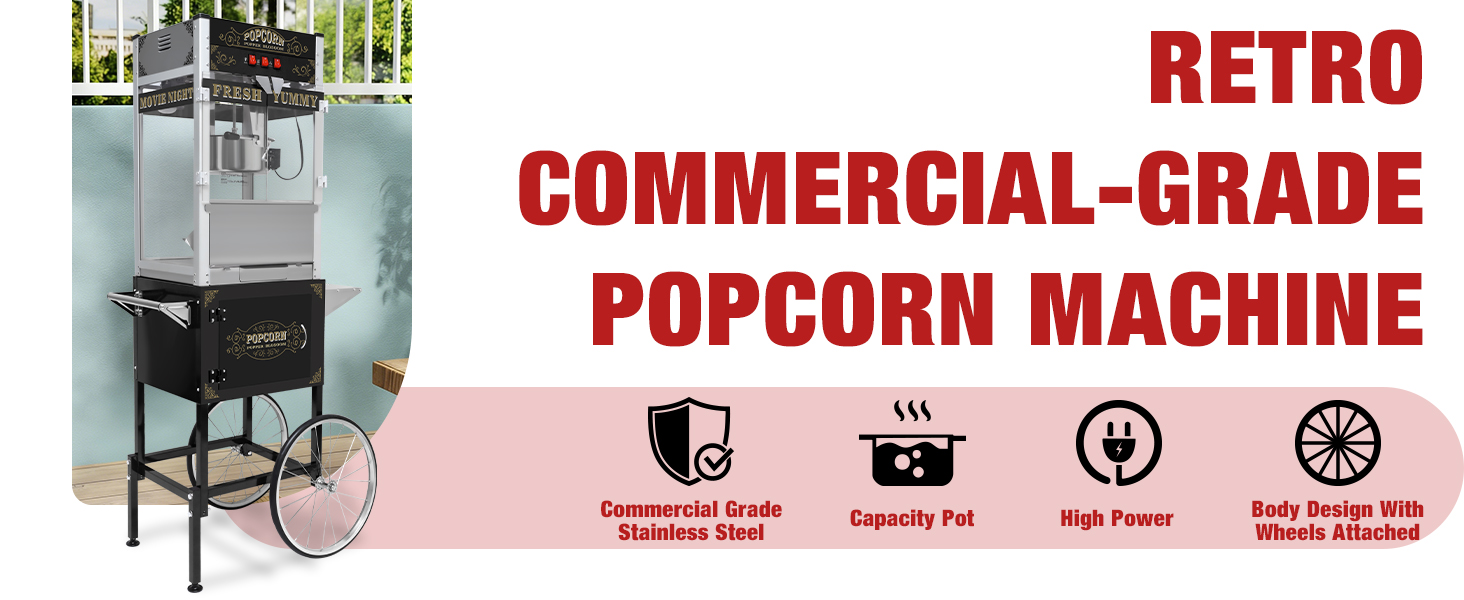
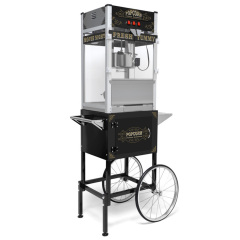
It is not a small popcorn machine with a handle bolted on. Chamber, kettle and cabinet are sized as one unit on the frame, and the build is shop-grade rather than appliance-grade: a food-grade 304 stainless steel body, a clear popping chamber so you can watch a batch fill, and a metal kettle inside it rather than a coated pan. Panels are glossy black with gold lettering — restrained enough for a kitchen, tidy enough for a shop front — and the cabinet below the chamber opens into a storage compartment for corn, oil and tubs.
Before it lands, three checks come up on almost every order a popcorn machine company takes for a cart. Measure the tightest doorway and the turning space at the corner, because a cart is only mobile if the route allows it. Check where the nearest outlet sits, since the run of the cord decides where the cart can park. And plan the lift — the machine is not light, so two people and a ramp beat one person and a staircase.
Specifications
| Model | XH-P1205 |
|---|
| Format | Wheeled popcorn cart for dual-use commercial work |
| Kettle capacity | 20 oz |
| Batch yield | About 1,000 g per drop |
| Cycle time | About 6 minutes |
| Heating method | Heating tube |
| Power | 1,440 W |
| Supply | AC 120 V 60 Hz |
| Body material | Food-grade 304 stainless steel |
| Controls | Temperature control with thermal protection |
| Overall dimensions | 777 × 522 × 1621 mm |
| Machine weight | 28.28 kg |
| Supplied with | Popcorn scoop and measuring spoons |
Running a Batch & Cleaning Down
- Park the wheeled popcorn cart where the batch will be served and close to the outlet, and check the run of the cord before anything is filled.
- Switch the warmer on first, so the chamber is already holding heat when the first batch drops into it — the order that matters on a dual use popcorn machine, whether it is warming up for a shop shift or a film night.
- Measure the corn and the oil with the scoop and spoons that came with the machine; on a 20 oz popcorn machine an even measure is what keeps batch two tasting like batch one.
- Load the kettle, close the chamber door, and start the pot heater and the stirrer.
- Watch the chamber rather than the clock. When the popping slows to a few kernels at a time, the batch is ready.
- Empty the kettle so the corn drops to the floor of the chamber, switch the pot heater off, and leave the warmer on to hold the batch at serving temperature.
- Reload the kettle while the first batch is being served — that overlap is what keeps a queue moving, and it is the rhythm a commercial popcorn machine is built for.
- At the end of the day, switch everything off and let the kettle cool completely before lifting it out. The kettle and the key working parts are washable; on this 304 stainless steel popcorn machine the cabinet and the chamber simply wipe down with a damp cloth.
Heat Control & Safety
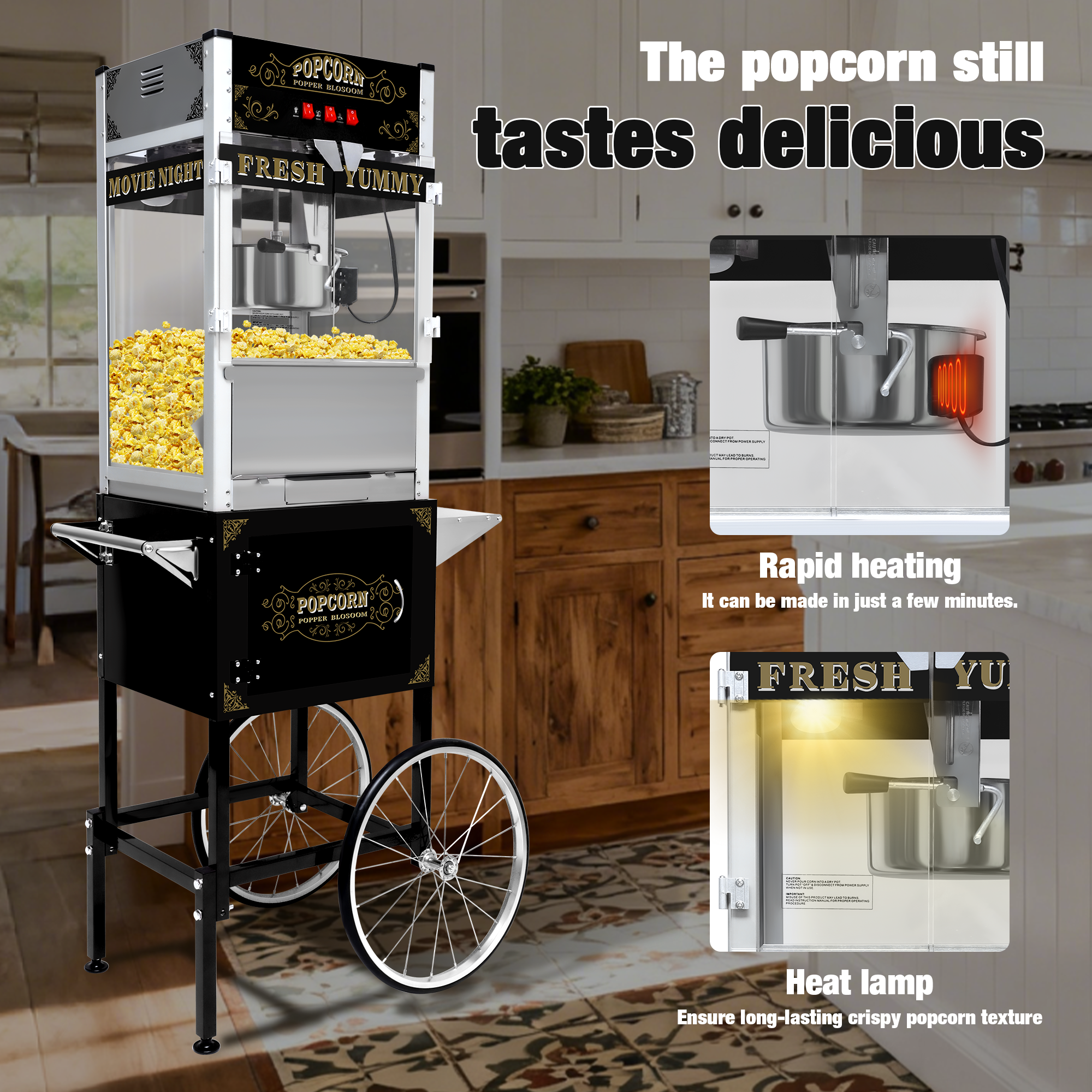
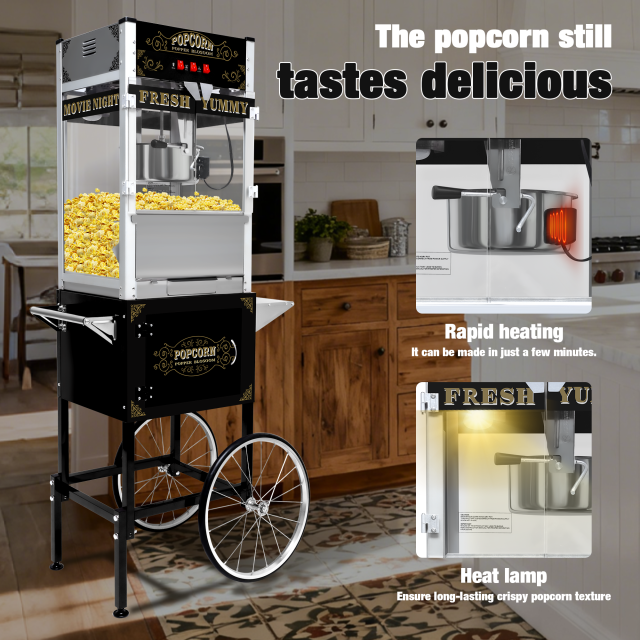
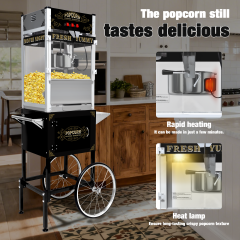
- A heat lamp over the batch — finished corn sits under the lamp instead of going cold between customers, so the second half of a batch on a commercial popcorn machine tastes like the first.
- Temperature control on the kettle — the heater is regulated rather than left to climb, which is what keeps consecutive batches close in colour and in pop rate.
- Thermal protection — if the kettle runs hot, protection cuts the heater before the corn scorches or the element takes damage. That is the difference between one wasted batch and a repair.
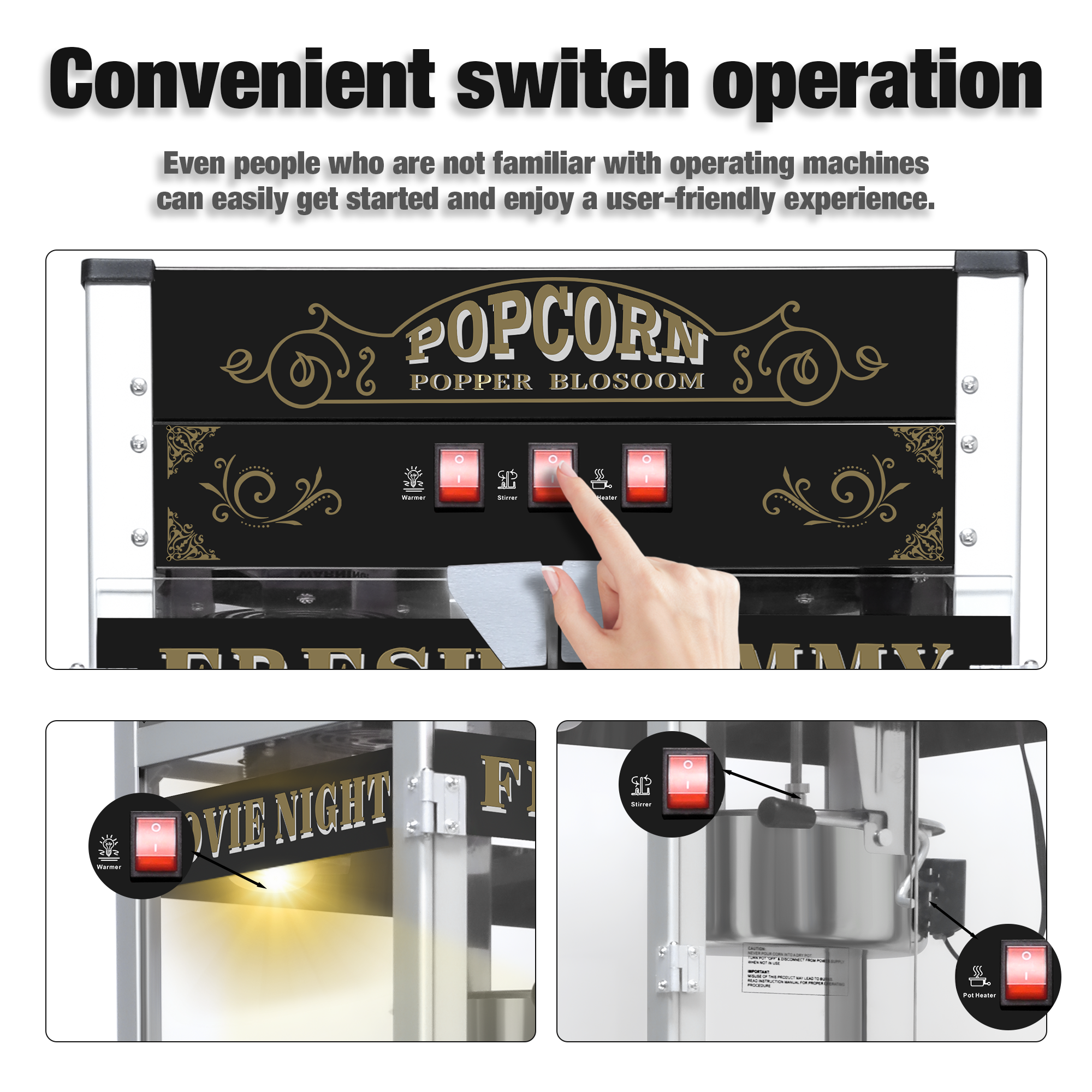
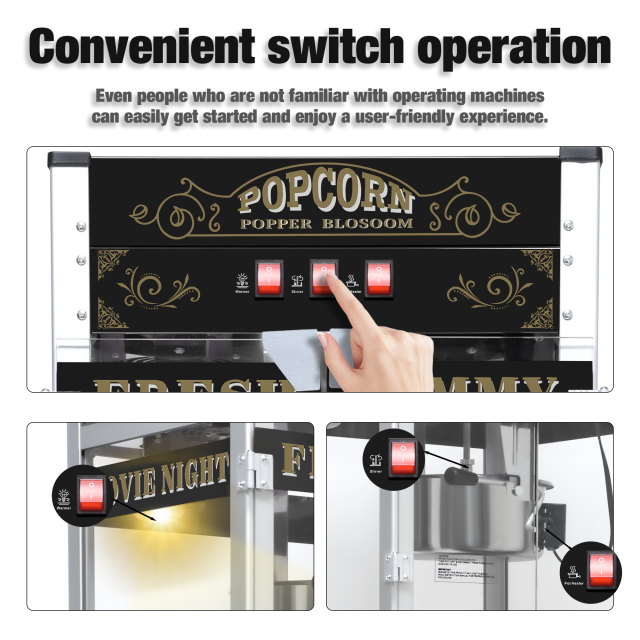
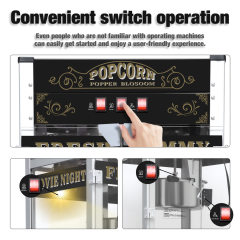
- Three switches, three jobs — warmer, stirrer and pot heater each have their own rocker switch, so corn can be held warm with the kettle switched off, or stirred without heat — the sort of control a popcorn machine company keeps simple on a cart.
- Easy to hand over — staff who have never run a popper, or who have only used a small popcorn machine at home, are usually shown once: fill, switch on, watch, empty. There is no sequence of levers to learn before the first batch.
- If a batch scorches — the usual causes are a kettle left heating with nothing in it, or corn left sitting after the popping stops. The temperature control and thermal protection cover the rest; on a dual use popcorn machine those are the two habits worth learning first.
Ordering & Delivery
- Confirm the model and the supply. This cart is built for the North American mains shown in the specification table, so check it matches the site before the order goes in.
- Confirm the quantity. Our minimum order is 100 pieces.
- Confirm the terms. We quote FOB, CIF, CNF or another arrangement at quotation stage, and mass production usually runs on a 30% advance with the balance before shipment.
- Confirm the schedule. Mass production usually takes 45 to 60 days depending on the model, so put that date into your launch plan rather than assuming stock.
- Confirm the packing and the delivery point. If your channel needs a particular carton, pallet or print, say so and we will pack to it.
- Ask about sample availability and about OEM work before you commit to volume — as popcorn machine manufacturers we would rather settle both before a production slot is booked. Send the site details and the quantity you have in mind and we will come back with a quotation.
Packing List & First Setup
- The cart arrives as one assembled unit: the kettle is mounted inside the popping chamber, the chamber is fixed to the cabinet, and the wheels and push handle are already on the frame. Unstrap it, stand it level, and check the kettle sits square in its cradle before the first switch-on.
- A popcorn scoop and a set of measuring spoons come with the machine. The spoons are sized for corn and for oil, so the measure used on the first batch is the measure every later batch gets.
- The storage compartment under the chamber is empty on arrival. It is where the scoop, the spoons, the corn and a day's tubs travel once the cart is parked in position.
- Popping corn, oil, seasoning and serving tubs or bags are not part of the shipment. Order them before the cart lands, or the first batch waits on a delivery van.
- Packing follows the order. If your channel needs a particular carton, a pallet configuration or printed outer packaging, raise it at quotation stage and we pack to it.
- Ask your sales contact to confirm the packing list against your order: the carton and pallet count, and whether a spare lamp or heating element ships with the cart as standard.
- A setup video and product visuals go out with the machine, which is usually enough to walk counter staff through the controls and to fill a product listing before the cart goes live.
Scale & Supply Capability
MEPK has manufactured popcorn machines since 2005 and runs two factories of our own: a 60,000 m² plant in Zhejiang and a 20,000 m² plant in Thailand, together around 80,000 m², with more than 100 people on the team. The Thailand site works under a five-year tariff exemption, which keeps unit costs down and keeps supply steady when order volumes rise. We hold US and EU certification, release three to five new models each quarter, and take OEM and custom orders from 100 pieces, with product visuals and installation videos supplied for launch.
FAQ
Q1. Is this just a mini popcorn machine on wheels?
No — the cart is the machine, not an add-on. Chamber, kettle and cabinet are built as one unit on the wheeled frame, and the compartment underneath is part of the body rather than a shelf bolted on. That is what lets it carry a full-size kettle and a day's stock at the same time.
Q2. Is one kettle enough for a busy counter?
For a queue that arrives in waves, yes — the kettle reloads while the previous batch is being served, so the case stays full. What it will not do is run continuously: one kettle means one batch at a time, and at that point a larger machine is the better buy. As a popcorn machine supplier we would rather say that now than have you find out on a Saturday.
Q3. What comes with the cart?
The cart arrives with the kettle and chamber fitted, plus a popcorn scoop and a set of measuring spoons for corn and oil — the same accessory set we send with our countertop popcorn machines. Ask your sales contact to confirm the packing list on your order.
Q4. Can we order it with our own branding?
Yes. OEM and custom orders are part of what we do as a popcorn machine company, including the tooling and the packaging that go with them. Your sales contact will confirm which details can be changed on this cart and how that affects the schedule.
Q5. Can this model run on 220–240 V?
This cart is built for 120 V 60 Hz, the standard North American supply. If the site or the market you ship into runs a different voltage, raise it with your sales contact before ordering — a machine built for the wrong supply is not something you fix with a plug adapter.